Paediatric Ophthalmology
Paediatric Ophthalmology
Introduction
Paediatric ophthalmology focuses on the diagnosis, treatment, and long-term management of eye problems affecting infants, children, and adolescents. Children often cannot clearly articulate vision difficulties, making early eye examination essential for detecting hidden visual problems before they affect learning and development.
Common conditions managed at Focus Eye Centre include refractive errors, squint (strabismus), amblyopia (lazy eye), watering eyes, ocular allergies, congenital cataract, and developmental vision disorders. Healthy vision plays a central role in a child's education, concentration, coordination, and social development — timely paediatric eye care is therefore essential for preventing permanent visual weakness and its consequences.
Causes
Refractive errors such as myopia, hyperopia, and astigmatism are among the most common causes of blurred vision in children. Squint may develop due to weak eye muscle coordination or uncorrected refractive error. Amblyopia occurs when one eye fails to develop adequate visual strength during the critical period of visual development in early childhood.
Congenital eye disorders, premature birth, family history of eye disease, allergies, blocked tear ducts, and excessive screen exposure also contribute to paediatric eye problems. Many parents seek specialist consultation when children complain of headaches, avoid reading, sit too close to screens, or show difficulty recognising distant objects.
Treatment
The treatment plan for each child depends on the specific diagnosis and age. Spectacle correction is prescribed for refractive errors. Amblyopia treatment typically involves patching therapy to strengthen the weaker eye. Squint management may require spectacles, orthoptic exercises, or surgery depending on severity. Ocular allergies are treated with medications and protective measures, while congenital eye problems may require early surgical correction.
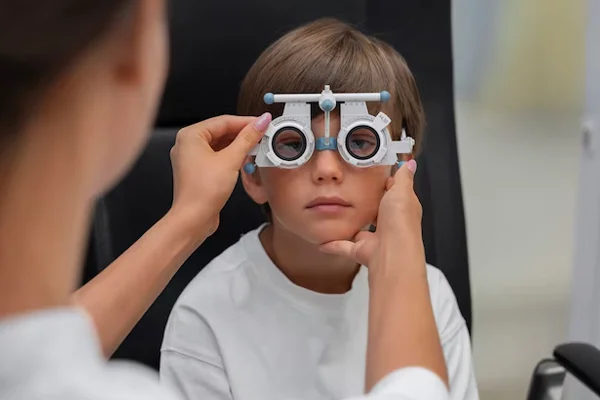
At Focus Eye Centre, children undergo vision testing, eye alignment assessment, retinal evaluation, and a comprehensive paediatric eye examination in a child-friendly environment designed to minimise anxiety and ensure accurate assessment. Early treatment consistently provides the best visual outcomes because the visual system is most responsive during childhood.
Benefits
Early paediatric eye care prevents permanent visual weakness and supports healthy visual development. Timely treatment improves learning ability, reading performance, concentration, and confidence in daily activities. Correction of squint and refractive errors at an early stage also supports normal binocular vision development and long-term eye coordination.
Frequently Asked Questions
1. At what age should a child have their first eye examination?
A basic eye examination is recommended during early childhood and again before starting school.
2. Can excessive mobile use affect children's eyesight?
Yes. Prolonged screen exposure increases eye strain and may worsen or accelerate the development of refractive errors.
3. Is squint treatable in children?
Yes. Early treatment consistently produces excellent results.
4. Can amblyopia (lazy eye) improve if detected early?
Yes. Early diagnosis and prompt treatment with patching therapy provide the best chance of improvement.
5. Why do children need regular eye screening?
Many childhood eye conditions produce no obvious symptoms but can significantly affect vision development and academic performance if left undetected.